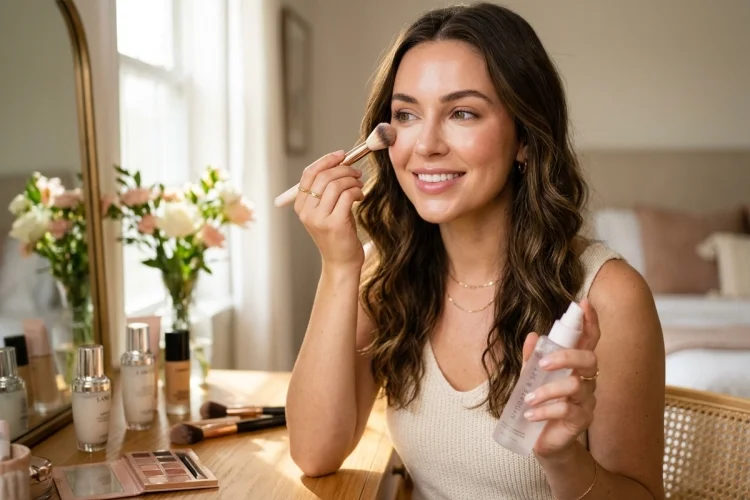
Setting your makeup can feel like a difficult balancing act. You want foundation and concealer to stay in place for hours, but the moment you add too much powder, your complexion can suddenly look flat, cakey, or noticeably dry.
The good news is that setting makeup does not mean covering your entire face with a heavy layer of translucent powder. In fact, one of the easiest ways to achieve a fresher result is to use setting products only where they are actually needed.
Learning how to set your makeup without making skin look dry comes down to three main ideas: prepare your skin properly, use powder strategically, and choose a finishing method that matches your skin type.
Setting spray can also help create a softer-looking finish when you do not want additional powdery texture.
Whether you have naturally dry skin or simply dislike an overly matte complexion, these beginner-friendly techniques can help your makeup stay polished without sacrificing a natural, comfortable appearance.
1. Start With Properly Hydrated Skin
Long-lasting makeup begins before foundation.
If your skin already feels tight or flaky, adding powder later can make those areas even more noticeable. The American Academy of Dermatology explains that dry skin develops when the skin loses too much water and recommends regular moisturizer to help retain moisture.
Apply a moisturizer that suits your skin type before makeup and give it time to settle.
You do not need an extremely thick layer. The goal is simply to make your complexion feel comfortable rather than greasy or slippery.
Pay particular attention to areas where powder usually looks dry, such as around the mouth, cheeks, or under the eyes.
When the skin underneath your makeup feels balanced, you generally need less effort to make your final base look smooth.
2. Do Not Powder Your Entire Face Automatically
One of the most useful makeup setting tips is surprisingly simple: not every part of your face needs powder.
If your forehead becomes shiny but your cheeks stay dry, there is little reason to heavily powder both areas.
L’Oréal Paris specifically recommends applying setting powder only where needed for dry skin, while people with combination skin can focus on areas prone to shine such as the forehead, nose, and chin.
This targeted approach helps preserve the natural finish of your foundation.
For example, you might set around the sides of your nose, lightly powder the center of your forehead, and leave the outer cheeks mostly untouched.
The result can still look polished without creating an all-over matte layer.
Think of setting powder as a problem-solving tool rather than a mandatory coating.
3. Choose a Lightweight Setting Powder
Not all powders behave the same way.
A heavy, highly mattifying formula may be useful for someone with very oily skin, but it can be more difficult to wear on a dry complexion.
For dry skin, L’Oréal Paris recommends lightweight, finely milled loose powder and emphasizes using it selectively rather than covering the entire face.
Maybelline also notes that setting powder can still be used on dry skin when the complexion is properly hydrated and the powder is applied strategically.
The texture of the powder matters because finer products are often easier to distribute in thin layers.
Regardless of the formula, start with very little.
You can always add more powder to an oily area later in the day. Removing a thick, dry-looking layer is much harder.
4. Use a Small Amount of Powder
When it comes to setting makeup without cakiness, quantity matters enormously.
You rarely need as much powder as you see in dramatic “baking” tutorials.
Dip a fluffy brush or small powder puff into the product, then tap off the obvious excess.
Maybelline describes setting powder as a fine product designed to sit over liquid complexion makeup without requiring a thick layer.
Start underneath your eyes if you need to set concealer, then move to areas where makeup tends to shift.
For a natural everyday look, the brush should almost look as though it contains too little product.
That is usually better than starting with too much.
After applying, step away from the mirror. If your complexion still looks like skin rather than powder, you are probably using the right amount.
5. Be Extra Careful Around the Under-Eyes
The under-eye area is one of the easiest places for makeup to look dry.
Concealer, fine lines, and setting powder can quickly become a heavy combination if each product is applied generously.
Before powdering, make sure your concealer has been blended into a thin layer.
If it has already settled into lines, gently tap the area with a fingertip or damp sponge first.
Then apply a tiny amount of powder only where concealer tends to move.
Avoid repeatedly layering powder throughout the day unless you really need it.
Remember that under-eye skin naturally has texture. Trying to eliminate every visible line with extra makeup often makes the area look heavier rather than smoother.
A slightly luminous, natural under-eye can look fresher than one that is completely matte.
6. Consider Using Setting Spray Instead of More Powder
Setting spray is especially useful when you want makeup longevity without adding another dry layer.
L’Oréal Paris notes that a lighter setting mist can be useful for dry skin because it can finish makeup without creating additional powdery texture.
For very dry makeup looks, the brand has also suggested choosing setting spray instead of relying heavily on powder.
Setting sprays come in different finishes.
Some are matte, while others are dewy, natural, or luminous. If dryness is your main concern, a softer or dewy finish may be more comfortable than an aggressively mattifying option.
NYX, for example, offers dewy setting sprays specifically designed to leave makeup looking fresher and more luminous.
The best choice depends on your skin and the finish you prefer.
7. Apply Setting Spray From the Correct Distance
How you use setting spray matters.
Holding the bottle extremely close to your face can leave large droplets that disturb foundation or create uneven patches.
Maybelline recommends holding setting spray approximately six to eight inches away from the face and applying it in an X followed by a T formation.
NYX similarly recommends spraying from roughly six to ten inches away depending on the product.
Close your eyes and mist the product evenly across your completed makeup.
Then leave it alone.
Do not immediately wipe, rub, or press your face while the setting spray is wet. Let it dry naturally.
You want the skin lightly misted, not dripping.
Using more spray does not automatically make makeup last longer.
8. Use Powder and Setting Spray Together Strategically
You do not have to choose between powder and spray.
For many people, combining small amounts of both gives the best balance between longevity and a natural finish.
Apply powder only around areas where makeup tends to move or become shiny. Once the entire makeup look is complete, mist a light layer of setting spray over the face.
NYX recommends using powder first and then finishing with a setting mist, noting that the spray can help the layers appear more seamless.
This combination is particularly useful for combination skin.
Your T-zone can stay more controlled while your cheeks retain a softer appearance.
The key is moderation.
If you use a heavy powder layer and then completely soak your face in spray, the final result may still feel uncomfortable.
9. Avoid Over-Mattifying Naturally Dry Areas
Not every area of your face needs to look completely shine-free.
Natural skin reflects some light.
Trying to eliminate every bit of luminosity can sometimes make the complexion appear flat.
If your cheeks naturally stay dry, consider leaving them mostly unpowdered. You can allow cream blush, subtle highlighter, or a satin foundation finish to maintain some natural dimension.
Focus oil-control products on the areas that genuinely become oily.
This is especially helpful for combination skin, where treating the entire face as either “dry” or “oily” often creates problems.
Your nose might need powder while your cheeks need none at all.
Customizing your setting routine by facial zone can create a much more believable finish.
10. Refresh Dry-Looking Makeup Instead of Adding Powder
Midday touch-ups can sometimes make dryness worse.
Imagine your foundation looks slightly textured around your mouth after several hours. Adding another layer of powder is unlikely to solve that problem.
Instead, inspect what your skin actually needs.
If the issue is excess shine, lightly blot first and add a minimal amount of powder.
If your complexion simply looks dull or powdery, a light setting or refreshing mist may help restore a softer appearance.
Some hydrating makeup sprays are specifically designed to refresh makeup as well as set it. NYX, for example, markets its Bare With Me spray as a product that can prime, set, and refresh the complexion.
The practical lesson is simple: do not automatically respond to every makeup problem with more powder.
Sometimes your makeup needs less product, not more.
11. Check Your Makeup in Natural Light
Bathroom mirrors can make it surprisingly difficult to notice excess powder.
Before finishing your routine, stand near a window and look at your complexion in daylight.
Pay attention to areas around your nose, under your eyes, between your brows, and around your mouth.
If you can clearly see powder sitting on the surface, gently blend the area using a clean fluffy brush or damp makeup sponge.
You can also apply a light setting mist afterward.
Check your skin from a normal distance rather than using a magnifying mirror.
Real skin contains pores, lines, and texture. The goal of setting makeup is to help your products stay in place while maintaining a natural appearance-not to create perfectly textureless skin.
Learning how to set your makeup without making skin look dry is mostly about using setting products selectively.
Hydrate your complexion first, choose a lightweight powder, and apply it primarily where foundation or concealer tends to move or where excess shine develops.
Dry cheeks usually do not need the same amount of powder as an oily T-zone. A setting spray can also help you finish your makeup without adding another powdery layer, especially when you prefer a fresh or dewy appearance.
Most importantly, avoid assuming that more powder automatically means longer-lasting makeup.
During your next routine, try using half your usual amount of setting powder and apply it only where necessary. Finish with a light mist, let everything dry naturally, and check your complexion in daylight. Your makeup may last just as well while looking noticeably fresher.