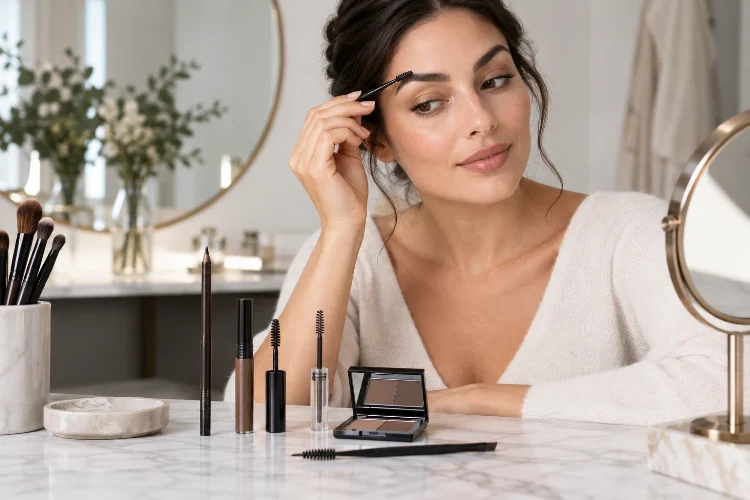
Eyebrow makeup looks simple until you actually try to buy some.
One beauty aisle can contain micro pencils, thick pencils, powders, pomades, clear gels, tinted gels, waxes, pens, and products that somehow combine several of those things in one tube.
If you are completely new to brow makeup, figuring out where to start can feel harder than filling in the brows themselves.
Fortunately, you probably do not need most of them.
Learning how to choose the right eyebrow product for beginners starts with looking at your natural brows and deciding what you want to change. Some people only need to keep unruly hairs in place.
Others want to fill a few gaps, add definition, or create the appearance of fuller eyebrows. Different products solve different problems.
Once you understand what pencils, powders, gels, pomades, and pens actually do, choosing one becomes much easier – and you can avoid building a drawer full of products you rarely use.
1. Start by Looking at Your Natural Eyebrows
Before choosing a product, spend a minute looking at your brows without makeup.
Are they already fairly full but the hairs point in different directions? Do you have noticeable gaps? Are the tails sparse? Or are your brows naturally light and mostly need additional color?
Your answer should guide your purchase.
Maybelline’s eyebrow guide similarly recommends first identifying whether your brows need filling, shaping, darkening, or simply holding in place before deciding on a product.
This approach is much easier than selecting whatever product happens to be popular on social media.
For example, someone with full but unruly brows may get everything they need from a clear gel. Someone with sparse areas will probably benefit more from a pencil or powder.
The goal is not automatically to create completely new eyebrows. For everyday beginner makeup, enhancing what is already there is usually easier.
2. Brow Pencil Is the Most Versatile Starting Point
An eyebrow pencil is one of the safest choices when you want greater control.
It is especially useful for filling small gaps, defining the tail, or improving the overall shape without putting pigment across the entire brow.
Modern micro pencils usually have very fine tips, allowing you to create short marks that resemble brow hairs. L’Oréal recommends using pencils for sparse areas and blending afterward with a spoolie to keep the finish natural.
The technique matters.
Instead of drawing one heavy line from the front of the brow to the tail, make several small strokes following the direction of your natural hairs. Use less pressure near the inner brow and slightly more definition toward the outer section.
Then brush everything through with a spoolie.
This softens harsh marks and distributes excess pigment.
Pencils require a little practise, but they are forgiving enough for most beginners because you can build the color gradually.
Who Should Choose a Brow Pencil?
Choose one if you have noticeable gaps, short brow tails, or want more precise control over your shape.
It is also useful if your brows are uneven and need slightly different amounts of correction on each side.
3. Clear Brow Gel Is Probably the Easiest Beginner Product
If filling in your eyebrows feels intimidating, start with clear brow gel.
It works almost like hairstyling gel for eyebrow hairs. You brush the hairs into your preferred position, and the formula helps hold them there.
There is very little opportunity to make a dramatic mistake because you are not adding pigment.
Maybelline specifically describes clear brow gel as one of the easiest options for beginners because it primarily involves brushing the existing hairs into place.
Clear gel works particularly well for people who already have naturally dense brows but want them to look cleaner and more intentional.
You can brush the front hairs slightly upward, follow the natural direction across the middle, and guide the tail outward.
Avoid applying too much at once. Excess gel can sometimes make hairs feel stiff or leave visible residue when it dries.
For a basic five-minute makeup routine, brow gel may be all you need.
4. Tinted Brow Gel Adds Color and Hold at the Same Time
Tinted eyebrow gel is essentially the next step up from clear gel.
It holds the hairs while also depositing a small amount of color. This can make the brows look slightly fuller without requiring you to draw every missing hair manually.
Maybelline notes that tinted gels can darken existing brow hairs while helping tame them, making them a practical option for people who want a quick brow routine.
NYX similarly describes brow gel as a product that can tame, shape, and hold eyebrow hairs, with different formulas offering different levels of color and control.
This is a great choice for busy mornings.
Simply wipe excess formula from the applicator, then brush through the brow with light movements. If the brush carries too much product, it can deposit a dark spot on the skin, so starting with less is safer.
Tinted gel is especially useful for light-colored or medium-density brows that mainly need definition rather than major reshaping.
5. Brow Powder Creates a Softer, More Diffused Look
Eyebrow powder looks similar to eyeshadow but is designed in brow-friendly shades.
Rather than creating very sharp individual hairs, powder tends to produce soft shading. This makes it useful when you want to make sparse brows look fuller without creating highly defined edges.
Apply it with a small angled brush.
Start around the middle or tail of the brow, where more definition is usually needed, then use whatever product remains on the brush toward the front.
This prevents the inner brow from becoming too dark or blocky.
Powder can be especially flattering if you prefer softer, natural-looking makeup. It is also useful when you have reasonably good brow shape but want to fill larger areas of low density.
The main downside for a complete beginer is that powder usually requires an additional angled brush, so it is slightly less convenient than a pencil or gel.
Still, it is relatively forgiving because the edges can be blended easily with a spoolie.
6. Brow Pomade Gives Stronger Definition
Pomade is a cream-like brow product usually packaged in a small pot and applied with a thin angled brush.
It can create strong definition, precise tails, and deeper color. Because it is often highly pigmented, a tiny amount can cover a surprisingly large area.
L’Oréal describes pomade as an option for creating more defined, longer-lasting brow looks, while Anastasia Beverly Hills recommends using small amounts and hair-like strokes rather than heavily loading the brush.
Pomade can work particularly well for very sparse brows or when you want a sharp, polished makeup style.
However, it is not necessarily the easiest first product.
Using too much can quickly produce extremely dark, solid-looking brows. Beginners who want to experiment with pomade should remove excess product from the brush before touching the brow and work in thin layers.
A spoolie can rescue many mistakes by blending away excessive pigment.
Pomade is worth learning eventually, but you do not need to start there.
7. Brow Pens Are Great for Hair-Like Detail
Brow pens usually have very fine felt or brush tips and dispense liquid pigment.
Their main advantage is the ability to draw tiny, individual strokes in places where natural hairs are missing. Used carefully, they can produce a realistic feathered effect.
For example, Maybelline instructs users of its brow pen to make small upward flicking motions through sparse areas before setting the hairs with gel.
But pens require a steadier hand than gels or powders.
Applying too much pressure can produce thick marks instead of delicate hairs, so beginners should practise lightly on the back of the hand before working around the eyebrows.
A pen can be particularly useful if the front of your brow has gaps or if you want to extend a thin tail without creating a visibly drawn line.
Think of it as a detail tool rather than something you necessarily need to fill the entire brow.
8. Choose the Right Eyebrow Shade
Even perfect technique can look unnatural if the color is wrong.
The safest starting point is your natural brow hair rather than the hair on your head. These are not always exactly the same color.
Maybelline suggests that people with lighter eyebrow hair can often use a slightly deeper shade for added definition, while those with very dark brows may prefer an exact match or a slightly lighter shade for a softer effect.
Avoid automatically choosing pure black just because your hair is dark.
Deep brown, ash brown, soft black, or neutral tones can sometimes create a less severe result.
Undertone also matters. Some brow products lean warm and reddish, while others are cooler and ashier.
If your eyebrows suddenly look orange or strangely gray, the problem may be the undertone rather than your application technique.
9. Match the Product to the Look You Want
There is no universal “best eyebrow product.”
For an almost invisible makeup look, clear gel may be enough. For quick color and control, use tinted gel. For filling specific gaps, choose a pencil.
Powder gives a softer shaded effect, while pomade creates stronger definition. A brow pen is ideal when realistic-looking individual strokes are the priority.
You can also combine products once you become more confident.
For example, lightly fill gaps with pencil and finish with clear gel. Or use powder through the middle and tail, then add a few pen strokes around sparse areas.
Do not assume more products automatically create better brows.
One well-chosen product can definately look better than four products applied too heavily.
10. Keep Brow Tools and Products Clean
Eyebrow makeup is used very close to the eyes and directly against the skin, so basic hygiene matters.
Keep spoolies and angled brushes clean rather than allowing weeks of product buildup. The American Academy of Dermatology recommends washing makeup brushes every seven to ten days because brushes collect makeup residue, oils, dirt, and microorganisms.
Avoid sharing your brow brushes and makeup with other people as well. The AAD notes that shared cosmetics and applicators can transfer oils, dead skin cells, and microorganisms between users.
Store products properly with lids firmly closed.
If a gel, pomade, or pencil develops a strange smell, unusual texture, or obvious change in performance, it may be time to replace it rather than trying to keep using it.
Good hygiene is not the most exciting part of brow makeup, but it should be part of the routine from the start.
Learning how to choose the right eyebrow product for beginners becomes much easier when you begin with your natural brows instead of beauty trends.
Clear gel is the simplest choice for controlling existing hairs, while tinted gel adds convenient color. Pencils work well for filling gaps, powders create softer fullness, pomades offer stronger definition, and brow pens help create detailed hair-like strokes.
You do not need to master every product.
Choose one that solves your biggest brow concern, apply a small amount, and spend time learning how it behaves. Once that feels comfortable, experiment with another formula if you want more definition or staying power.
Most importantly, keep your touch light. Your brows do not need to be perfectly identical or dramatically reshaped to look polished. Start simple, blend often, and let your natural brow structure do most of the work.