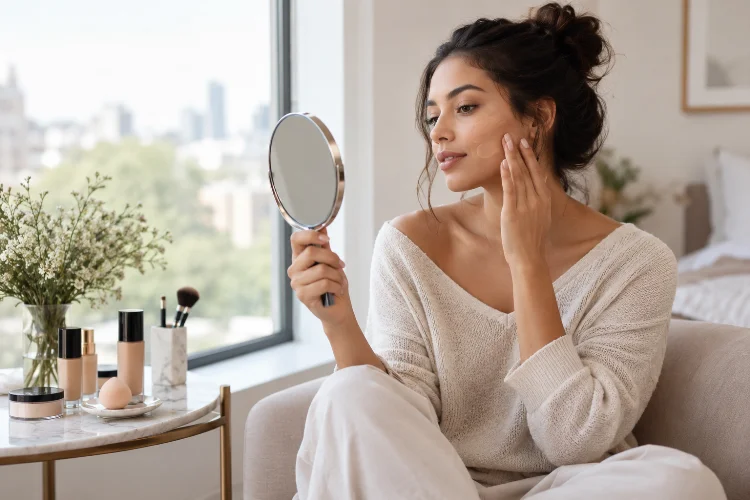
Foundation shopping can get confusing surprisingly fast. You may find two products in almost identical bottles, yet one gives a barely-there tint while the other can cover redness, blemishes, and discoloration in a single layer.
The difference often comes down to coverage.
Understanding how to choose foundation coverage for your daily look can make your makeup routine easier, faster, and much more comfortable.
Instead of automatically reaching for the highest coverage available, you can choose a formula based on how much of your natural skin you actually want to show.
Some days, a sheer skin tint may be enough. On others, medium coverage might give you the polished appearance you want. Full coverage also has its place, especially when you want a more uniform complexion.
The goal is not to hide your skin. It is to find the right balance between coverage, comfort, finish, and your everyday lifestyle.
Here is how to make that decision without turning foundation shopping into a science experiment.
1. Understand What Foundation Coverage Means
Foundation coverage describes how much the product visually conceals or evens out when applied to the skin.
A low-coverage formula allows freckles, minor redness, and natural skin variation to remain visible. Higher-coverage foundation contains enough pigment to make discoloration, blemishes, and uneven areas less noticeable.
Most products fall somewhere between sheer, light, medium, and full coverage.
L’Oréal describes sheer foundation as an option for subtly evening the complexion while allowing characteristics such as freckles to remain visible. Medium coverage provides more correction while still maintaining a skin-like appearance.
Coverage should not be confused with finish. A foundation can be full coverage and luminous, or light coverage and matte.
Think of coverage as how much it hides, while finish describes how the surface looks.
2. Choose Sheer or Light Coverage for a Natural Everyday Look
If your main goal is simply making your complexion look slightly more even, sheer or light coverage may be all you need.
These foundations tend to let your natural skin show through. Freckles remain visible, minor redness may still appear, and the final effect often resembles “your skin, but more even.”
This can work particularly well for casual days, working from home, running errands, or situations where you want makeup without feeling heavily made up.
Skin tints and tinted serums frequently fall into this category. A small amount can be blended quickly with fingers, making them useful for routines where you only have a few minutes.
Maybelline similarly recommends light coverage when you want a natural, barely-there appearance.
The limitation is obvious: light coverage will not completely conceal stronger pigmentation, acne marks, or pronounced redness.
But that does not necessarily mean you need heavier foundation everywhere. You can use light coverage across the face and apply concealer only where additional correction is needed.
That approach often looks more natural and uses less product.
3. Medium Coverage Is the Everyday Sweet Spot for Many People
Medium foundation sits between barely-there makeup and a highly perfected base.
It usually provides enough pigment to soften redness, minor blemishes, uneven skin tone, and some discoloration without completely covering natural skin texture.
For this reason, medium coverage is often one of the most practical options for everyday makeup.
It works for the office, classes, lunches, meetings, dates, and many other situations where you want to look polished without creating a dramatic makeup look.
Another advantage is buildability.
Many medium-coverage foundations allow you to apply one thin layer across the face and then add a second small amount only where necessary.
Maybelline describes medium coverage as the middle ground between sheer and full formulas and notes that many options can be gradually built up.
That flexibility is useful because most faces do not need identical coverage everywhere.
Your cheeks might need almost nothing, while redness around your nose or an old blemish may benefit from more pigment.
Using foundation selectively can create a much more natural result.
4. Use Full Coverage When You Actually Need More Correction
Full-coverage foundation is designed to create a more uniform-looking complexion.
It can significantly reduce the visible appearance of acne marks, hyperpigmentation, redness, and other areas you want to conceal. Maybelline categorizes full coverage as the option for people wanting stronger correction of blemishes or uneven pigmentation.
That makes it useful for special occasions, photography, evening events, or simply days when you personally prefer a more perfected base.
But full coverage does not need to become the default for everyday makeup.
More pigment means application becomes increasingly important. Thick layers may collect around facial lines or look heavier when viewed closely, particularly if your skin is dry or the foundation is not blended carefully.
Start with a thin layer even when using a high-coverage formula.
You may discover that one small pump already provides more than enough coverage.
And remember that full coverage does not mean your makeup has to look unnatural. Good skin preparation, proper shade matching, and careful blending can make a big difference.
5. Let Your Skin Type Influence the Formula
Coverage matters, but your skin type also affects how comfortable a foundation feels throughout the day.
If your skin tends to become shiny quickly, you may prefer a matte or natural-finish foundation. The American Academy of Dermatology recommends oil-free and non-comedogenic products for people with oily or acne-prone skin.
Dry skin often feels better with hydrating liquid formulas and satin or luminous finishes.
Someone with combination skin may want something between the two: perhaps a natural-finish medium foundation, followed by powder only in areas that become oily.
Do not assume that coverage itself determines whether a foundation suits your skin.
A full-coverage foundation can still be moisturizing, while a sheer formula can be matte.
Look at the complete description: coverage, finish, ingredients, texture, and intended skin type.
That little bit of research can prevent a lot of dissapointment after buying the wrong product.
6. Match Your Coverage to Your Daily Lifestyle
Your ideal everyday foundation should work with your actual schedule.
Imagine someone who spends most of the day in a relaxed office environment. A lightweight medium foundation may provide enough polish without requiring a complicated routine.
Someone who works from home might prefer sheer coverage because it takes only a few minutes to apply.
Meanwhile, someone attending a long formal event may choose greater coverage because they want the complexion to remain more consistent in photographs and throughout the evening.
Weather matters too.
A foundation that feels comfortable during cool weather may feel completely different on a hot, humid day.
You can even own more than one foundation rather than expecting a single bottle to solve every situation.
For example, keep a lightweight skin tint for casual days and a medium-to-full coverage product for times when you want more correction.
Makeup becomes much easier once you stop treating every day as though it requires exactly the same routine.
7. Consider How Much of Your Natural Skin You Want Visible
This is one of the simplest ways to choose coverage.
Stand in front of a mirror without makeup and ask yourself what you actually want foundation to change.
If you mostly like your complexion and simply want everything to look slightly more even, choose sheer or light coverage.
If redness and discoloration bother you but you still want your skin to look natural, medium coverage may be a better choice.
If you prefer a highly uniform base, full coverage might make more sense.
There is no correct answer.
Freckles, pores, texture, and minor discoloration are normal features of real skin. Foundation can reduce their appearance, but you do not automatically need to cover them.
Choosing coverage based on your preferences rather than social media trends usually results in makeup that feels much more comfortable and personal.
8. Learn to Build Coverage Instead of Applying Too Much
You can always add foundation, but removing excess product without disturbing everything underneath is much harder.
Start with a small amount in the center of your face and blend outward. Areas around the nose, chin, and inner cheeks often need more coverage than the outer edges of the face.
After the first layer, look at your complexion before adding anything else.
If one spot still needs correction, add a small amount there instead of applying another thick layer everywhere.
A damp sponge can create a softer finish, while a foundation brush may retain more pigment and give slightly stronger coverage.
Learning this technique means one buildable foundation can potentially create several different looks.
On Monday, you might wear one thin layer. For Saturday night, you could gradually add a little more.
That is usually more versitile than treating the foundation’s advertised coverage as a strict rule.
9. Do Not Ignore Shade, Finish, and Makeup Hygiene
Even perfect coverage will look wrong if the foundation shade does not match your complexion.
Test shades around the jawline when possible so you can compare the foundation with both your face and neck. Give the product a little time to settle before making a final judgement.
Finish matters as well.
Matte formulas reduce visible shine, luminous foundations create more glow, and natural or satin finishes sit somewhere in between. Maybelline identifies natural, matte, and luminous as common foundation finish categories.
Finally, keep your products and tools clean.
The American Academy of Dermatology recommends avoiding shared makeup and cleaning brushes regularly, particularly if you are prone to breakouts.
Foundation itself can also deteriorate over time. Cleveland Clinic recommends watching for changes in smell, texture, color, and performance as signs that cosmetics may need to be replaced.
If your old foundation suddenly smells wierd or separates in an unusual way, replacing it is safer than trying to make it work.
Learning how to choose foundation coverage for your daily look becomes much easier once you stop assuming that more coverage automatically means better makeup.
Sheer and light formulas are ideal when you want natural skin to remain visible. Medium coverage provides a flexible balance between correction and a skin-like finish, while full coverage offers stronger concealment when you want a more uniform base.
Consider your skin type, daily activities, desired finish, and how much of your natural complexion you want to show.
Most importantly, experiment with thin layers instead of immediately using large amounts. Try different coverage levels on ordinary days and pay attention to which one still feels comfortable several hours later.
Your best daily foundation is not necessarily the one that hides the most – it is the one that makes your routine easier and your skin look the way you want it to look.