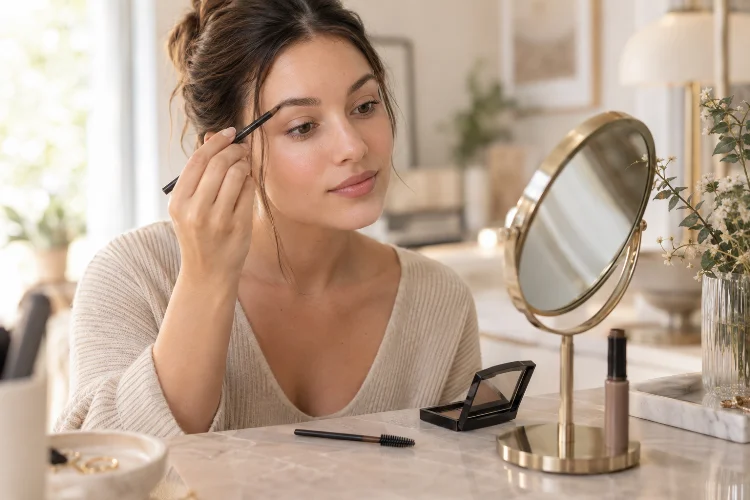
Sparse brows can be surprisingly tricky to fill. Add too little product and the gaps are still obvious. Add too much, and suddenly your eyebrows look darker, sharper, and far more dramatic than you intended.
The secret is not simply finding a stronger eyebrow product. In most cases, natural-looking brows come from using less product in smarter places.
Learning simple ways to fill sparse brows without looking harsh means paying attention to your existing brow shape, choosing a realistic shade, creating small hair-like details, and blending before the color becomes too intense.
You are trying to create the illusion of additional brow hairs, not draw two completely new eyebrows onto your face.
The good news is that this technique does not require professional makeup skills. A pencil, powder, brow gel, spoolie, or combination of two simple products can be enough.
Whether your eyebrows are naturally thin, uneven, or simply have a few empty areas, these techniques can help you create softer, fuller-looking brows without losing their natural character.
1. Brush Your Brows Before Adding Any Color
Before reaching for a pencil, brush your eyebrow hairs upward and slightly outward with a clean spoolie.
This simple step makes it easier to see where the actual gaps are. You may discover that your brows are not as sparse as they first looked; some hairs may simply be lying flat or pointing in different directions.
Maybelline recommends brushing brow hairs upward and outward before filling them because this helps separate the hairs, reveal the natural shape, and identify areas that need additional definition.
Once the hairs are arranged, look carefully at the front, arch, and tail.
Do not automatically apply product across the entire eyebrow. If only the tail looks thin, focus there. If you have one small gap in the middle, fill that area seperately.
Selective application is one of the easiest ways to prevent heavy-looking brows.
2. Use Short Hair-Like Strokes Instead of Solid Lines
One of the biggest differences between natural and harsh-looking brows is the type of mark you create.
Avoid drawing one continuous dark line along the lower or upper edge of the brow. Instead, use a fine eyebrow pencil to make short strokes that imitate individual hairs.
L’Oréal recommends light, feathered pencil strokes through sparse areas when creating a natural brow look rather than heavily coloring the entire eyebrow.
NYX gives similar guidance, suggesting short strokes followed by blending with a spoolie to soften the result.
Pay attention to hair direction too.
Near the front of the eyebrow, hairs often grow more vertically. Through the middle and tail, they generally begin pointing outward.
Following those directions makes your pencil marks less obvious.
Keep your hand relaxed and use very little pressure. You can always add another stroke, but removing a thick dark mark without disturbing the rest of your makeup is much more annoying.
3. Keep the Front of the Brow Softer
A common mistake is making the inner part of the eyebrow as dark as the arch and tail.
Natural eyebrows usually contain visual variation. The front often appears softer and less sharply defined, while the middle and outer sections can look denser.
Maybelline notes that natural-looking brows tend to require less makeup at the front, while additional definition may be more useful around the arch and outer portion.
A simple technique is to begin filling your brows around the middle instead of the inner corner.
Once most of the pigment has left your pencil, brush, or applicator, lightly work whatever remains toward the front. This naturally creates a softer gradient.
If the beginning of your brow already has enough hair, you may not need pigment there at all.
Sometimes brushing those hairs upward with clear gel is enough.
4. Choose a Brow Shade That Is Not Too Dark
Even perfectly applied brow makeup can look harsh when the shade is overly deep.
For a natural effect, choose a color close to your existing brow hairs. L’Oréal recommends matching the natural brow shade as closely as possible and suggests going slightly lighter rather than darker when an exact match is unavailable.
People with very dark hair do not automatically need an intense black eyebrow product.
Depending on your natural coloring, deep brown, neutral brown, ash brown, or soft black may create a more believable finish.
Undertone is important as well.
If your natural brows have a cool or neutral tone, an overly warm reddish-brown pencil may look obvious even when the depth is correct.
Test a few strokes and check your brows in daylight when possible. Artificial bathroom lighting can sometimes make colors look quite different.
5. Try Brow Powder for Soft, Diffused Fullness
If pencils always seem too sharp for your taste, brow powder can be a beginner-friendly alternative.
Powder creates more of a soft shadow behind existing brow hairs rather than obvious lines. This makes it particularly useful for larger sparse sections where you want the brow to appear slightly denser.
Use a small angled brush and pick up only a little product.
Start around the arch and tail, then slowly blend toward the center. Use whatever tiny amount remains on the brush near the front.
The result should look like subtle depth behind the hairs rather than a painted surface.
Powder can also be combined with pencil. For example, use powder for general fullness and add only two or three pencil strokes where obvious gaps remain.
The combination often looks more natural than trying to create every detail with one heavily applied product.
6. Use Tinted Brow Gel When You Already Have Enough Hair
Sometimes your eyebrows are not actually missing many hairs. They simply look sparse because the individual hairs are fine, light, or difficult to see.
Tinted brow gel can help in this situation.
The small brush coats existing hairs with color while helping them stay in place, making the eyebrow appear fuller without drawing heavily onto the skin.
Brush the product through the hairs with a light hand. Remove excess formula from the applicator first, especially if the gel is highly pigmented.
For particularly sparse spots, you can use a pencil first and then apply gel afterward to blend everything together.
Clear gel is another option if your natural brow color is already strong enough.
For beginners who dislike drawing eyebrows every morning, gel can definately be one of the quickest options.
7. Blend More Than You Think You Need To
If your brows look too strong after filling them, do not immediately remove everything.
Pick up a clean spoolie and brush through the hairs.
Maybelline specifically recommends blending repeatedly with a spoolie after filling sparse areas because this helps distribute pigment and soften an overly obvious finish. NYX also recommends brushing away harsh edges after applying brow pencil.
Brush gently in the direction of hair growth.
This can remove excess pigment sitting on top of the hairs while spreading color more evenly across the brow.
You can also step away from the mirror for a moment.
Brows that look unfinished from five inches away may look completely natural at normal conversational distance. Constantly staring into a magnifying mirror can tempt you to keep adding product where you do not actually need it.
Learning when to stop takes practise.
8. Avoid Creating an Overly Sharp Brow Outline
Instagram-style brows popularized very precise edges, but that level of sharpness is not necessary for everyday makeup.
Drawing a dark border around the entire eyebrow can make even naturally full brows appear artificial.
Instead, focus definition where it creates the most benefit.
A little structure beneath the arch can make the brow appear cleaner. Extending a sparse tail slightly may improve balance. But the upper edge and inner corner usually do not need strong outlines for a soft everyday look.
L’Oréal’s beginner brow guidance recommends working with the natural brow shape and using hair-like strokes when filling sparse sections.
If you accidentally create a harsh line, use a spoolie to break it up before adding more product.
Remember: texture is your friend. Real eyebrows contain separate hairs and small variations rather than one perfectly solid surface.
9. Work in Layers Instead of Trying to Finish in One Pass
Sparse brows often look harsh because too much pigment is deposited too quickly.
Think of eyebrow makeup like building coverage with foundation. Start light, look at the result, and then decide whether another layer is actually necessary.
Fill the most obvious gaps first.
Brush everything through.
Then step back and compare both eyebrows before making further adjustments.
You may notice that one brow needs alot more correction than the other. That is completely normal. Eyebrows are naturally asymmetrical, so using exactly the same amount of product on both sides can sometimes make them look less balanced rather than more balanced.
Do not chase perfect symmetry.
Aim for brows that feel related rather than identical.
10. Keep Your Brow Tools Clean
Natural-looking application also depends on clean tools.
Old product buildup can make an angled brush stiff and cause powder or pomade to apply unevenly. A dirty spoolie can also redistribute old cosmetics, skin oil, and debris through the brows.
The American Academy of Dermatology recommends washing makeup brushes every seven to ten days because brushes can collect product residue, dirt, oil, and microorganisms.
The AAD also advises against sharing makeup brushes and applicators, particularly because microorganisms and skin oils can transfer between people.
Keep your pencil capped, wash reusable brushes regularly, and replace brow products if their texture, smell, or performance changes noticeably.
It is a small habit, but it helps keep both your application and your routine cleaner.
The best way to fill sparse brows naturally is not to cover every empty space with heavy pigment. Instead, work with the brow hairs you already have.
Brush them into place first, identify the areas that genuinely need help, and use light hair-like strokes, soft powder, or tinted gel to create subtle fullness.
Keep the front lighter, choose a believable shade, and use a spoolie whenever your makeup begins looking too defined. Most importantly, build the result slowly.
Try these techniques the next time you do your brows and experiment with using slightly less product than usual.
You may be surprised by how little makeup is actually needed to make sparse eyebrows look fuller, polished, and balanced while still looking completely like your own brows.