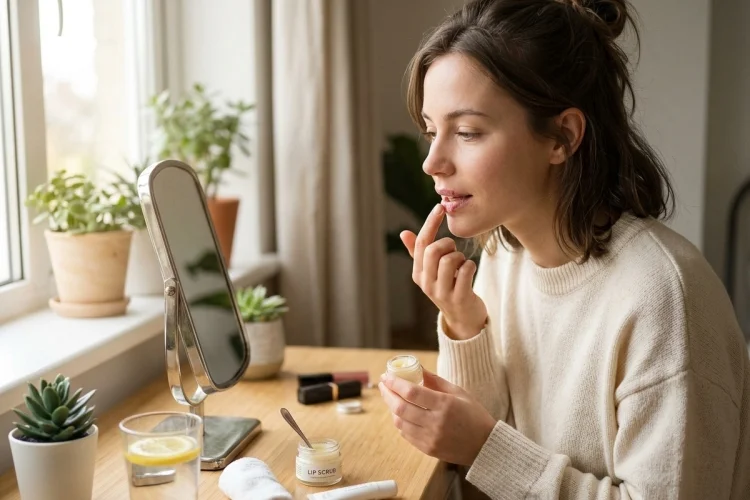
You find the perfect lipstick shade, apply it carefully, and then notice something frustrating: every tiny dry patch on your lips suddenly looks ten times more obvious.
Matte formulas can emphasize flakes, while even creamy lipstick may apply unevenly when your lips are severely dry.
The solution is not necessarily buying another lipstick. Sometimes your lips simply need better preparation.
Learning how to prepare dry lips before applying any lipstick can help lip color look smoother, more even, and more comfortable.
The process does not need to involve aggressive scrubbing or a complicated collection of lip products. In fact, gentle care is usually better when your lips are already dry or sensitive.
Chapped lips can be triggered by factors such as dry weather, sun exposure, dehydration, and frequent lip licking. Cleveland Clinic also notes that the lips lack oil glands, making them particularly vulnerable to dryness.
With hydration, careful exfoliation when appropriate, and the right lip balm, you can create a much better canvas for your favorite lipstick.
1. Understand Why Dry Lips Affect Lipstick
Lipstick tends to reveal texture rather than hide it.
When the surface of your lips contains loose, flaky skin, pigment can collect around those areas. This can create patchy color, rough edges, and an uneven finish.
Matte and long-wearing lipsticks may make this particularly noticeable because they usually have less shine and can visually emphasize texture. L’Oréal Paris recommends preparing the lips before lipstick because dry and flaky areas can interfere with smooth application.
Dry lips may develop for several reasons.
Cold weather, hot and dry conditions, sunlight, dehydration, and repeatedly licking your lips can all contribute to chapping. Certain products can also cause irritation.
That means lip preparation should not simply be about temporarily hiding flakes. Maintaining healthier-feeling lips between makeup days is just as important.
2. Start With Clean Lips
Before doing anything else, remove old lipstick, lip gloss, foundation, and other product residue.
Use a gentle makeup remover or damp cloth rather than aggressively rubbing the lips.
Starting with clean lips allows you to see their actual condition. You may realize that what looked like dry skin was partly old lipstick collecting in the natural lines of your mouth.
L’Oréal Paris recommends beginning a dry-lip routine with a clean surface before exfoliating or adding moisturizing products.
After cleansing, take a closer look.
If your lips are simply a little flaky, gentle preparation may be useful. If they are severely cracked, bleeding, swollen, or painful, skip aggressive cosmetic preparation and concentrate on allowing them to recover.
Lipstick can wait until your lips feel more comfortable.
3. Exfoliate Gently-But Do Not Overdo It
Exfoliation is probably the most frequently recommended step before applying lipstick to flaky lips.
The key word is gently.
L’Oréal Paris suggests using a damp washcloth to lightly massage away visible flaky patches before applying lip color.
You can also use a lip scrub designed specifically for this purpose.
However, more exfoliation does not mean smoother lips. Repeatedly scrubbing already irritated skin may make your lips feel even more uncomfortable.
When Should You Skip Exfoliation?
If your lips are cracked, bleeding, sore, or extremely sensitive, leave the scrub alone.
Focus on hydration and protection instead.
For mildly flaky lips, use very light pressure for a short period rather than trying to remove every piece of dry skin in one session.
L’Oréal Paris also cautions against overdoing lip exfoliation because irritation can result.
Think of exfoliation as occasional maintenance rather than something that must happen every single time you wear lipstick.
4. Apply a Comfortable Lip Balm
After gentle exfoliation-or immediately after cleansing if you skipped exfoliation-apply lip balm.
This is one of the most useful steps for dry lips.
The American Academy of Dermatology recommends applying a non-irritating lip balm or moisturizer several times throughout the day and before bed.
For very dry or cracked lips, a thicker ointment such as white petroleum jelly can help seal in moisture for longer.
Cleveland Clinic also recommends products containing moisturizing or protective ingredients such as petroleum jelly, glycerin, ceramides, dimethicone, mineral oil, or castor seed oil.
Apply enough balm to comfortably coat your lips.
Then give it time to work while you do the rest of your makeup.
This is much more effective than applying balm two seconds before lipstick and immediately wiping everything away.
5. Remove Excess Balm Before Applying Lipstick
Lip balm is helpful, but too much can create another problem.
If your lips are extremely slippery when you apply lipstick, the pigment may move around, become patchy, or struggle to stay inside your lip line.
After allowing the balm to sit for several minutes, gently press a tissue against your lips.
Do not remove every trace.
You simply want to take away the heavy surface layer while leaving your lips feeling soft.
L’Oréal Paris recommends allowing lip balm to absorb before gently removing excess when lipstick will be applied afterward. This can help prevent the lip color from sliding around.
The ideal surface should feel moisturized but not greasy.
This step is particularly useful when applying matte or long-wearing liquid lipstick, which often performs best on a relatively smooth, clean surface.
6. Protect Your Lips From the Sun
Lip preparation is not only something you should think about five minutes before lipstick.
Daily protection matters too.
The American Academy of Dermatology recommends using a non-irritating lip balm containing SPF 30 or higher before going outdoors. The organization also recommends reapplying lip protection approximately every two hours while outside.
Sun exposure can contribute to dry, damaged lips.
If you regularly wear lipstick during the daytime, consider using SPF lip balm as part of your morning preparation before applying color.
Allow it to settle before adding lip products, just as you would with a regular balm.
Remember that the lipstick itself should not automatically be assumed to provide sufficient sun protection unless the product is specifically labeled with an SPF.
Healthy-looking lipstick starts with protecting the skin underneath it.
7. Stop Licking and Picking at Dry Lips
When your lips feel dry, licking them can feel like the quickest solution.
Unfortunately, it can make the problem worse.
The American Academy of Dermatology specifically recommends avoiding licking, biting, and picking at dry lips. Cleveland Clinic provides similar guidance and identifies frequent lip licking as a common contributor to chapped lips.
Picking is especially tempting before lipstick.
You notice one small flake and try to pull it away, only to remove healthy skin along with it and leave behind a painful spot.
Instead, apply balm and allow the dry skin to soften naturally.
If a loose piece eventually comes away easily after gentle cleansing, that is very different from pulling at attached skin.
Good lip preparation is sometimes about knowing what not to do.
8. Choose a Lipstick Formula That Works With Dry Lips
Lip preparation can improve almost any lipstick application, but formula still matters.
If your lips are consistently dry, an extremely matte liquid lipstick may simply feel less comfortable than a cream, satin, balm-style, or moisturizing formula.
You do not need to stop wearing matte lipstick completely.
Just recognize that it may require more careful preparation and occasional touch-ups.
Maybelline recommends moisturizing the lips before lipstick and notes that lip primer can also provide a smoother base, particularly when using matte formulas that make lip lines more visible.
For everyday makeup, consider choosing a creamy or satin lipstick when your lips are having a particularly dry day.
Save your more demanding matte formula for when the skin has recovered.
Makeup should adapt to the condition of your lips, not the other way around.
9. Consider Using Lip Primer for Matte Lipstick
Lip primer is optional, but it can be useful if you regularly wear matte or long-lasting lipstick.
A primer can create a smoother surface underneath color and may help improve how evenly lipstick applies.
L’Oréal Paris includes priming as a preparation step for liquid lipstick after gentle exfoliation.
You still do not need several heavy layers.
Lip balm, primer, liner, lipstick, and gloss can quickly become too much if every product is applied generously.
Use thin layers.
If your lips already feel comfortable after balm, you may decide that primer adds very little to your routine.
As with face primer, consider it a useful option rather than a mandatory makeup rule.
10. Be Careful With Irritating Lip Products
Sometimes lips remain dry despite constant balm application because the product itself is irritating them.
Cleveland Clinic recommends avoiding lip products that cause burning, stinging, or tingling and notes that ingredients such as certain fragrances, flavors, menthol, eucalyptus, and camphor may irritate already chapped lips.
The FDA also notes that cosmetic ingredients-including fragrances, preservatives, and dyes-can cause allergic reactions in some people. Symptoms may include redness, itching, flaking, peeling, or swelling.
If a lip product consistently makes your lips feel worse, stop using it.
Do not assume that tingling means a product is “working.”
Pay attention to patterns too. If your lips suddenly become dry after introducing a new lipstick, lip balm, gloss, or lip-plumping product, temporarily removing that item from your routine may help identify the problem.
11. Know When Dry Lips Need More Than Makeup Prep
Most ordinary chapped lips improve with consistent moisturizing and avoiding irritating habits.
However, persistent problems deserve attention.
Cleveland Clinic advises contacting a healthcare provider when chapped lips become worse or fail to improve after several weeks of home care. Persistent lip inflammation can sometimes have causes beyond ordinary dryness.
Do not try to disguise severely irritated lips under thick lipstick.
If you notice ongoing cracking, significant swelling, sores, persistent pain, or repeated irritation, concentrate on resolving the underlying problem first.
A lipstick tutorial can help with cosmetic dryness, but it cannot diagnose or treat a medical condition.
Sometimes the best makeup preparation is simply giving your lips a break.
Learning how to prepare dry lips before applying any lipstick does not require an elaborate routine. Start with clean lips, gently remove loose flakes only when appropriate, and apply a comfortable lip balm that gives your lips time to soften.
Before lipstick, blot away excess balm so your lip color has a smooth but not slippery surface. Use SPF lip protection during the day, avoid licking or picking at dry skin, and adjust your lipstick formula when your lips need something more comfortable.
Most importantly, treat lip preparation as an ongoing habit rather than a five-minute emergency before wearing matte lipstick.
Tonight, apply a generous layer of your preferred non-irritating lip moisturizer before bed. Tomorrow, use gentle prep before your lipstick and compare the finish-you may find that smoother lip color starts long before you open the lipstick tube.