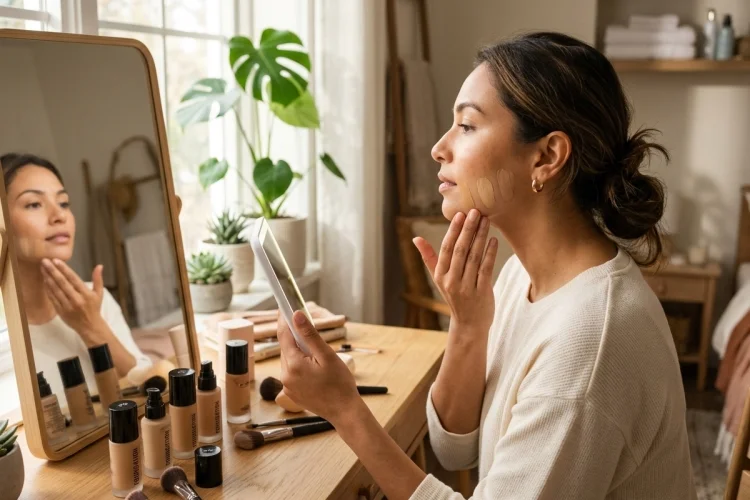
Finding foundation should be simple: pick a color that looks similar to your skin, blend it in, and move on.
In reality, almost everyone who wears makeup has probably experienced a foundation that looked perfect in the bottle but turned orange, pink, gray, or noticeably too light after application.
The problem is that finding the right foundation involves more than choosing between light, medium, or deep. You also need to consider your skin undertone, how the formula looks in different lighting, and whether its color changes after sitting on your skin.
Fortunately, learning how to find your true foundation shade easily at home does not require professional makeup training. With a mirror, natural daylight, a few comparison shades, and some patience, you can get surprisingly close to your ideal match.
This guide will walk you through the entire process, from understanding skin tone and undertones to performing an accurate jawline test and checking how a foundation looks after it has fully settled.
1. Understand Skin Tone Before Choosing Foundation
The first thing to identify is your general skin tone.
Skin tone refers to the visible depth of your complexion. Foundation brands commonly organize shades into groups such as fair, light, light-medium, medium, tan, deep, and variations in between.
Maybelline, for example, distinguishes skin tone from undertone and uses depth categories to help narrow foundation choices.
Do not overthink this first step.
Stand near a window during the daytime with a clean, makeup-free face. Look at your face, neck, and upper chest rather than concentrating on one tiny area.
Your face may sometimes look slightly lighter, darker, or redder than your neck because of sun exposure, skincare, acne, or irritation. The goal is therefore not simply to copy the exact color of your cheeks.
Instead, look for a foundation depth that can create a natural transition between your face and neck.
2. Learn the Difference Between Skin Tone and Undertone
This is where foundation matching becomes more interesting.
Your undertone is the subtle underlying hue beneath your visible skin color. Two people can both have medium skin, for example, while one has a warm undertone and the other has a cool undertone.
Common undertone categories include:
- Warm: golden, yellow, or peach tones
- Cool: pink, rosy, red, or bluish tones
- Neutral: a balance between warm and cool
- Olive: subtle greenish or muted golden characteristics
Clinique describes warm undertones as generally appearing peach, yellow, or golden, while cool undertones can appear pink, red, or blue. Estée Lauder similarly categorizes foundation undertones into cool, neutral, and warm families.
Finding the right depth with the wrong undertone is one reason a foundation can technically be “your shade” but still look strangely orange, pink, or gray.
3. Use At-Home Undertone Tests as Clues
Several popular tricks can help you estimate your undertone at home, although no single test should be treated as perfect.
Check Your Veins
Look at the veins inside your wrist in natural light.
Blue or purple-looking veins are often associated with cooler undertones, while greener-looking veins may suggest warmer tones. A mixture can point toward neutral skin. Maybelline also notes that olive undertones may show green characteristics.
However, use this as a starting clue rather than your final answer.
Try the Jewelry Test
Think about whether gold or silver jewelry tends to complement your complexion.
Gold is traditionally associated with warm undertones, while silver may complement cooler tones. If both look equally flattering, you may lean neutral.
Again, this is not an exact diagnostic tool. Your personal style and jewelry preferences can influence your judgment.
The most reliable answer usually comes when several clues point in the same direction and your actual foundation swatches confirm them.
4. Never Test Foundation Only on Your Hand
One of the easiest foundation mistakes is swatching shades on the back of your hand and immediately choosing a winner.
Your hands and face can have noticeably different coloring because they receive different levels of sun exposure and have different skin characteristics.
Instead, test foundation around the jawline, where you can compare the color against both your face and neck.
L’Oréal Paris recommends testing several neighboring shades along the jawline so you can evaluate how naturally they connect the face and neck. Maybelline also recommends jawline swatching when comparing undertones and shades.
Apply approximately three narrow stripes next to one another.
Choose one that looks slightly lighter than expected, one that appears closest, and one slightly deeper. Ideally, they should also have similar undertones.
The winner is usually the shade that seems to disappear into your skin rather than sitting visibly on top of it.
5. Always Check Your Foundation in Natural Light
Bathroom lighting can be surprisingly deceptive.
Warm indoor bulbs may make a foundation look more golden. Cool artificial lighting can make your skin and makeup appear different again.
This is why natural daylight is incredibly useful when trying to find your foundation shade at home.
After creating your jawline swatches, stand near a bright window without direct sunlight hitting your face. Look at the shades from a normal distance rather than pressing your face against the mirror.
Maybelline specifically recommends checking foundation swatches under different lighting conditions because a color that appears correct indoors can look noticeably different in daylight. L’Oréal Paris gives similar advice when evaluating a foundation match.
If one stripe almost disappears where your face meets your neck, you are probably getting close.
6. Wait Before Deciding: Your Foundation May Change Color
Do not immediately buy or reject a foundation based on how it looks during the first few seconds after application.
Some foundation formulas can appear different as they dry or interact with skincare, skin oils, and air. Makeup users often describe noticeable darkening or warming as oxidation.
A useful at-home experiment is to apply your potential matches and leave them untouched for around 10 to 15 minutes before comparing them again.
L’Oréal Paris recommends this waiting period when checking whether a foundation noticeably deepens or develops a more orange appearance.
Take a photo when you first apply the swatches.
Then take another photo after they have settled.
If your perfect-looking match becomes considerably darker, warmer, or more orange after several minutes, another shade-or possibly another formula-may suit you better.
7. Compare Your Face With Your Neck and Chest
A good foundation should help your complexion look connected rather than creating an obvious mask.
This becomes especially important when your face and neck naturally differ in color.
Perhaps your face becomes red easily. Maybe your neck receives less sun than your chest. In situations like these, simply matching foundation to your cheek may exaggerate the difference.
Step several feet away from your mirror and look at your entire upper body.
Ask yourself whether your face appears to belong naturally with your neck and chest.
L’Oréal Paris suggests considering the upper chest when the face and body differ noticeably in depth, rather than relying on the face alone.
Your goal is visual harmony, not matching every square centimeter perfectly.
8. Use a Foundation You Already Own as Your Reference
If you already have a foundation that almost matches, keep it.
Even an imperfect shade can become extremely useful when shopping online.
Start by identifying exactly what is wrong with it.
If the depth seems correct but the product looks orange, you may need a less warm undertone. If it looks pink, try something more neutral or warm. If the undertone seems correct but your face looks pale, move slightly deeper within the same undertone family.
Several beauty brands now offer digital foundation matching tools. Clinique, for example, provides a Foundation Finder and allows users to match from a shade they already wear. Sephora also provides an online Shade Finder designed to narrow foundation matches.
Estée Lauder similarly offers virtual shade matching, quizzes, and cross-brand matching tools.
These tools are useful for creating a shortlist, although checking the shade on your actual skin remains valuable whenever possible.
9. Remember That Your Foundation Shade Can Change
Finding your true foundation shade does not necessarily mean discovering one number that works forever.
Your complexion can look somewhat different throughout the year.
If you spend more time outdoors during sunnier months, for example, your usual foundation may eventually appear too light. Later, you may return closer to your original shade.
This is why some regular makeup users keep two nearby foundation shades.
Rather than buying a completely new product every time your complexion changes slightly, you can mix a lighter and deeper shade to create something in between.
Also remember that different brands use different shade systems. Being “Medium Neutral” in one foundation does not guarantee that another company’s medium-neutral shade will match exactly.
Always evaluate the actual color rather than relying entirely on the shade name.
10. Know What a Good Foundation Match Looks Like
The perfect foundation should not make your face dramatically lighter, darker, pinker, or more orange.
You should ideally have difficulty seeing where the product ends when it is properly blended along your jawline.
L’Oréal Paris recommends aiming for a true match instead of deliberately selecting a foundation lighter or darker than your complexion.
If you want your face to look brighter, use concealer strategically.
If you want more warmth, use bronzer.
Foundation itself should generally create the natural-looking base upon which those other products can work.
And if two shades look almost identical? Do not panic.
Foundation matching does not need to become a search for one mathematically perfect color. If a shade blends naturally into your face, neck, and overall complexion in normal daylight, you have probably found a very good match.
Learning how to find your true foundation shade easily at home becomes much simpler once you stop judging foundation by the bottle alone. First identify your approximate skin depth and undertone, then compare several nearby shades directly along your jawline.
Check your swatches in natural daylight, give the formula time to settle, and make sure your finished complexion blends naturally with your neck and chest.
Online shade finders can also help narrow your choices, especially when you already know a foundation shade that works reasonably well.
Most importantly, do not worry if your first attempt is not perfect. Foundation matching becomes much easier once you understand exactly what looks too warm, cool, light, or deep on your skin.
Grab three close shades, head toward a window, and try the jawline test yourself-the best match may be much easier to spot than you expect.