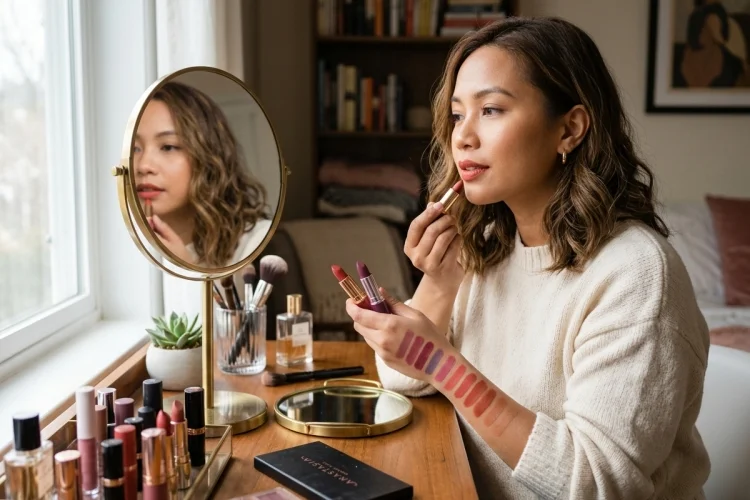
Have you ever loved a lipstick in the tube but felt completely different about it once it was on your lips? Maybe a nude shade made you look washed out, or a gorgeous red suddenly appeared more orange or pink than expected.
The reason is not necessarily that the color is “wrong.” Lipstick interacts with your skin tone, undertone, natural lip pigmentation, lighting, and even the other makeup you are wearing.
Learning how to choose lip colours that suit your skin tone can make lipstick shopping much easier. Instead of memorizing endless beauty rules, start by understanding two basic things: your skin depth and your undertone.
Beauty brands commonly describe undertones as warm, cool, or neutral. Warm complexions tend to have golden, yellow, or peach undertones, while cooler complexions lean pink, red, or bluish. Neutral undertones contain a balance of both.
Once you understand that foundation, choosing flattering nude, pink, red, berry, or brown lip colors becomes much less confusing.
1. Understand Skin Tone and Undertone First
Skin tone and undertone are related, but they are not the same thing.
Your skin tone describes how light or deep your complexion appears. Common categories include fair, light, medium, tan, deep, and many shades between them.
Your undertone is the subtle color underneath the visible surface of your skin. It is generally described as warm, cool, or neutral. NYX, for example, distinguishes skin depth from undertone when recommending lipstick shades.
This distinction matters because two people can both have medium skin while looking best in completely different lipstick colors.
Someone with medium warm skin may prefer terracotta or orange-red. Another person with medium cool skin may feel more comfortable in raspberry, blue-red, or mauve.
Think of skin tone as helping you choose the depth of a lipstick and undertone as helping you choose its color direction.
2. Find Your Undertone at Home
You do not need special equipment to make an educated guess about your undertone.
One common method is examining the veins on the inside of your wrist in natural daylight.
If they appear mostly blue or purple, you may lean cool. Greener-looking veins are commonly associated with warm undertones. If you see a mixture or cannot easily decide, you may have a neutral undertone. NYX and L’Oréal Paris both use this approach as a simple starting point.
However, do not treat the vein test as an exact scientific diagnosis.
Look at several clues.
You may notice whether golden or silver jewelry seems particularly harmonious with your complexion. You can also compare warm and cool clothing colors close to your face.
Ultimately, the best test is practical: compare actual lip colors and see which shades make your complexion look balanced.
3. Choose Lip Colours for Warm Undertones
If your skin has noticeable golden, yellow, or peach characteristics, you probably lean warm.
Warm-toned lipstick colors often include coral, peach, terracotta, warm red, burnt orange, caramel, and certain brown shades.
Maybelline recommends colors such as orange, red, coral, and warm pink for people with golden, yellow, or peach undertones. NYX similarly highlights warm options such as brick red, coral, and salmon.
For an everyday nude lip, experiment with peachy beige, caramel nude, warm rose, or soft brown.
If you want something bold, try orange-red, brick red, cinnamon, or deeper terracotta.
Do not assume warm skin means you can never wear blue-red or purple lipstick. These recommendations simply show which colors are likely to create an easy sense of harmony.
Sometimes contrast is exactly what makes a lipstick interesting.
4. Choose Lip Colours for Cool Undertones
Cool undertones usually contain pink, red, or bluish characteristics.
Lipsticks with a cooler base can complement these tones particularly well.
Popular options include blue-based red, raspberry, cranberry, mauve, dusty rose, cool pink, plum, and berry.
Maybelline recommends blue-based pinks, purples, and berries for cool undertones. NYX also suggests cool reds, purplish pinks, and dusty rose shades.
For a subtle everyday lip, try muted pink, rosy nude, or soft mauve.
For something stronger, experiment with classic blue-red, deep berry, wine, or plum.
If a lipstick repeatedly turns very orange against your complexion even though it looks neutral in the packaging, its undertone may simply be warmer than your skin.
That observation can become extremely useful when choosing your next shade.
5. Neutral Undertones Give You Plenty of Flexibility
Neutral undertones sit somewhere between warm and cool.
If you have neutral skin, you may find that both warm and cool lipsticks can work well depending on the rest of your makeup.
Maybelline notes that neutral undertones can experiment across a wider variety of lipstick shades.
That does not mean every color will automatically be perfect.
Depth still matters.
A nude that is dramatically lighter than your complexion, for example, can make the mouth look washed out regardless of undertone.
If you have neutral undertones, use this flexibility to experiment. Try rosy brown one day and warm caramel the next. Compare blue-red with brick red.
You may eventually discover that your favorites sit slightly warmer or cooler than technically “neutral.”
Personal preference matters more than fitting perfectly into a category.
6. Find a Nude Lipstick That Does Not Wash You Out
Nude lipstick is surprisingly difficult to choose because “nude” does not mean the same color for everyone.
A beige shade that looks natural on fair skin may look extremely pale on a deep complexion.
L’Oréal Paris recommends choosing nude-pink colors that relate closely to your natural lip color and cautions against going excessively light, which may create a washed-out appearance.
Start by looking at your natural lip pigmentation.
For fair skin, soft beige-pink, peach, or rose may create an easy nude.
Medium complexions can experiment with caramel, rose-brown, warm mauve, or deeper peach.
Tan and deep complexions may find richer caramel, chocolate, berry-brown, or deeper rosy nudes more flattering.
If a nude lipstick looks too pale, pair it with a slightly deeper lip liner.
This adds definition and can make a challenging shade much more wearable.
7. Find Your Version of Red Lipstick
There is no single universal red.
Red lipstick can lean blue, pink, orange, brown, or even slightly purple.
Your undertone can help narrow the possibilities. L’Oréal Paris notes that blue-toned reds may complement cool undertones, while warmer complexions can experiment with reds that contain warmer characteristics.
If you have cool undertones, try cherry, cranberry, raspberry-red, or classic blue-red.
Warm undertones may enjoy tomato red, orange-red, brick, or warm scarlet.
Neutral skin can usually move between both families.
Depth also changes the effect.
A bright red can create strong contrast against fair skin, while richer burgundy or deep crimson may appear more naturally integrated into deeper complexions.
The easiest way to find your red is to compare several red shades side by side instead of assuming “red lipstick” is one color.
8. Do Not Be Afraid of Dark or Bold Lip Colours
Beauty rules sometimes make bold lipstick sound unnecessarily restrictive.
In reality, almost anyone can wear berry, burgundy, orange, purple, brown, or dramatic red. The trick is finding a variation you enjoy.
For example, L’Oréal Paris notes that dark berries can create striking contrast on fair complexions, while richer purple, chocolate, and deep red shades can complement deeper skin tones.
Orange lipstick can work across skin depths too. L’Oréal Paris emphasizes undertone rather than claiming orange belongs to only one complexion category.
If a bold shade feels intimidating, start with a sheer version.
Apply lipstick lightly and tap it into your lips with a fingertip for a stained effect.
Once you become comfortable with the color, build toward full opacity.
A shade does not have to be subtle to be flattering.
9. Always Test Lipstick in Natural Light
Store lighting can completely change your perception of color.
Warm artificial lighting may make a lipstick appear more orange, while cooler lighting may emphasize blue or purple characteristics.
Whenever possible, check a lip shade near natural daylight before deciding whether it suits you.
L’Oréal Paris also recommends clear natural lighting when examining undertones.
If you are testing lipstick at home, take photos near a window.
Then compare how the shade looks with your entire face rather than studying only your lips.
Your natural lip pigmentation also influences the final color. The same lipstick can appear deeper, brighter, or more muted on different people.
This is why online swatches should be treated as references rather than guarantees.
The best test will always involve seeing how the color interacts with your own complexion.
10. Consider the Rest of Your Makeup
Lipstick does not exist in isolation.
Eyeshadow, blush, bronzer, and even clothing can change how a lip color feels.
L’Oréal Paris recommends considering the rest of your makeup when selecting lipstick. A stronger smoky eye, for example, may be paired with a more understated lip, while bright lipstick can become the main focus of a simpler makeup look.
You can also create harmony through undertones.
A peach blush paired with warm coral lipstick often feels naturally coordinated. Cool pink blush can work beautifully with rose or berry lips.
But contrast can be equally interesting.
There is no requirement that every color on your face belong to exactly the same family.
Use skin tone and undertone as useful starting points, then let your style decide the final combination.
11. Treat Lipstick Rules as Guidelines, Not Restrictions
Perhaps the most important lipstick tip is remembering that flattering does not mean mandatory.
If you have warm skin and love cool purple lipstick, wear it.
If beauty guides say your complexion works best with berry colors but you feel incredible in orange-red, that matters more.
Skin-tone recommendations are useful because they help explain why certain shades create harmony and others create stronger contrast.
They should not become rules that shrink your makeup options.
Instead, use your undertone to narrow an overwhelming lipstick collection into a few promising options.
Then experiment.
Your personal “perfect lipstick” is ultimately the shade that gives you the appearance, mood, and confidence you want.
Learning how to choose lip colours that suit your skin tone becomes easier once you separate skin depth from undertone.
Identify whether your complexion leans warm, cool, or neutral, then use that information to explore lipstick families that are likely to create natural harmony.
Warm undertones often pair beautifully with coral, terracotta, caramel, and warm reds, while cooler complexions can experiment with mauve, berry, dusty rose, and blue-red. Neutral undertones offer plenty of flexibility.
However, these are starting points rather than strict rules. Choose three lipstick shades from different color families and compare them in natural daylight.
Pay attention to how each shade changes your overall complexion-not just your lips. Over time, you will build your own personal color palette based on what actually looks and feels best on you.